A Conversation with Harman Gakhal
For this interview, I had the opportunity to sit down with Harman Gakhal, a recent graduate of UC Davis Law who is currently preparing for the California Bar Exam before beginning her career at Gordon Rees, a full-service law firm in Sacramento. Throughout our conversation, Harman shared honest insights about being a first-generation woman of color in law, overcoming imposter syndrome, networking, mentorship, and the importance of giving back to your community.
Her story reflects resilience, ambition, and the belief that success means bringing others up with you.
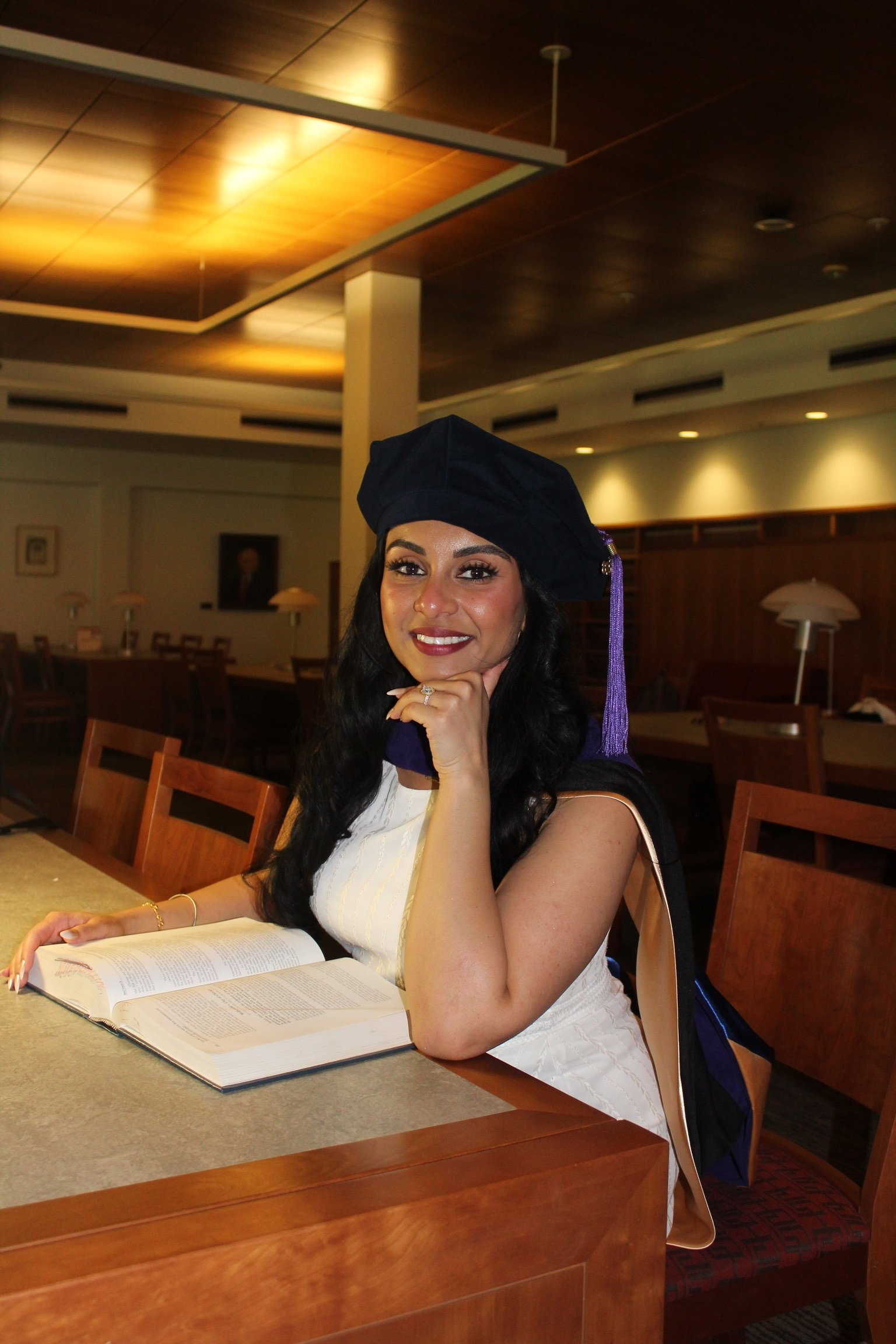
Harman Gakhal J.D
Woman in law regalia at a library
Q&A with Harman Gakhal
What inspired you to pursue law?
Harman: I actually knew really young. I was in seventh grade when I first became interested in being a lawyer. My parents are Punjabi immigrants, and growing up I didn't really have exposure to professional careers. I remember we had a career day project at school, and my mom wanted me to do my presentation on being a nurse. I was like, "I don't want to be a nurse."
So I started researching different careers on my own, and something about law immediately stood out to me. Ever since then, I've honestly never really questioned it. In high school, I joined mock trial, took a criminal law elective, and my interest just kept growing.
A lot of that passion comes from my background. Growing up in an immigrant community, I saw how often people didn't have access to legal knowledge or understand systems that directly affected them. Sometimes laws were being used against people who simply didn't know their rights or understand the language being used.
"It's power to be able to understand this legal language. And I think being able to bring that to your community is something that I really value."
Takeway: I really liked hearing that because I think a lot of first-generation students can relate to it. Law can feel like this completely different world that nobody teaches you about. Listening to Harman talk about wanting to bring that knowledge back to her community reminded me that becoming a lawyer isn't just about a career,it's also about creating access for people who may not have had it before.
What does “giving back” mean to you?
You talked a lot about community and helping others. What does giving back mean to you?
Harman: I've thought about that a lot because giving back can mean so many different things. Right now, I give back through education and mentorship. Whether that's being a pre-law advisor, helping first-generation students at King Hall, sharing outlines, answering questions, or just making myself available to people who need guidance.
I remember when I first got to law school, my mentor was honestly my lifeline. She helped me figure out what classes to take, how to study, how to navigate law school, and without her, my first year would've been so much harder.
Now that I'm in a position where I can help other students, I want to do that. I want to make things easier for the people coming after me.
For my home community, I also think about things like scholarships and creating opportunities for students who may not otherwise have access to them.
One thing I've always believed is:
"When you climb the ladder to get somewhere, you don't throw the ladder away. You extend it so other people can climb too."
Takeway I think that's probably one of my favorite quotes from our conversation.
As someone who met Harman through the Gonzalez Pre-Law Academy (GPLA) as my cohorts peer advisor, I can honestly say she practices what she preaches. Throughout the program, she was constantly answering questions, sharing advice, and helping students navigate a process that can feel overwhelming and intimidating.I also loved hearing her talk about mentorship because it reminded me of why programs like GPLA matter so much. For first-generation students especially, sometimes all it takes is one person showing you the way. Harman talked about how much her own mentors impacted her journey, and now she's doing the same thing for the next generation of students.One thing that stood out to me was that when she talked about success, she rarely talked about herself. Instead, she talked about helping other people succeed too. To me, that's what makes a great mentor.
How has your identity shaped your law school experience?
As a woman of color and a first-generation student, how has your identity shaped your experience in law school and the legal profession so far?
Harman: That's a really good question because I think it goes both ways.
Being a woman of color and being first-generation definitely came with moments where I questioned whether I belonged in certain spaces. Especially early on in law school, there were opportunities or environments where I felt like maybe I wasn't supposed to be there or that someone else was more deserving.
But over time, I realized that my background was actually one of my greatest strengths.
I was bringing perspectives into classrooms and workplaces that other people didn't have. I was able to understand experiences and communities that many people weren't familiar with. I also think growing up in diverse environments teaches you how to communicate with different types of people and navigate different spaces.
"You don't want your identity to decide what you deserve. But at the same time, your identity can absolutely become your strength."
Takeaway: I really connected with this answer because I think a lot of first-generation students and students of color have felt that same self-doubt at some point.One thing I appreciated was that Harman didn't pretend those feelings don't exist. Instead, she talked about learning how to reframe them.Throughout our conversation, she kept coming back to the idea that diversity isn't just something schools look for in an application. It's about the experiences, perspectives, and empathy that people bring with them.
I especially liked when she talked about how our backgrounds can help us connect with others. As someone who is also first-generation, I've often felt like I was entering spaces without a guidebook. Hearing Harman describe those experiences as strengths rather than disadvantages was honestly reassuring. Another point she made that stuck with me was that empathy can become a superpower. When you've had to work hard for opportunities or navigate unfamiliar systems, you often develop a level of compassion and understanding that can't really be taught in a classroom. That's something Harman believes has helped her throughout law school, and I think many students will relate to that.
Did you struggle with imposter syndrome?
Did you ever struggle with imposter syndrome or self-doubt during your journey?
Harman: Absolutely.
One of the hardest periods for me was during COVID. I was preparing to apply to law school, and everything felt uncertain. I was at home, trying to figure out the admissions process on my own, and I felt completely lost. I didn't know who to ask, what resources were available, or even where to start. I remember feeling stuck. Law school had always been my dream, but at that moment it felt so far away because I didn't have the same access to information or connections that other people seemed to have.
When I eventually got to law school, those feelings didn't disappear overnight. I think a lot of students experience imposter syndrome during their first year because everything is new. You're learning how to read cases, how to network, how to study, how to take exams, and how to conduct yourself professionally—all at the same time.
What helped me the most was reaching out to people.
"Closed mouths don't get fed."
Nobody gets where they want to be alone. You need mentors, you need community, and you need to be willing to ask for help.
I've never been afraid to cold email someone or send a LinkedIn message. If one person doesn't respond, that's okay. I'll ask somebody else.
"I might get ten nos, but I'll get an eleventh yes."
Takeaway: This part of our conversation really resonated with me because I think a lot of students assume successful people have everything figured out.
Listening to Harman talk about feeling lost during COVID reminded me that even people who seem incredibly accomplished have moments where they question themselves.
One thing she shared that made both of us laugh was a piece of advice she received from one of her mentors:
"Enter the room with the confidence of a white man."
As funny as it sounds, the message behind it was powerful.
Harman explained that many women, especially women of color, spend so much time questioning whether they belong in a room that they forget they worked just as hard to get there as everyone else. I immediately knew what she meant.
How many times have we talked ourselves out of applying for something because we didn't feel qualified enough? How many opportunities have we doubted ourselves out of pursuing? Meanwhile, there are people walking into those same spaces with half the experience and twice the confidence.
Confidence doesn't always come before the opportunity. Sometimes you have to walk into the room first and trust that you belong there.
What experiences impacted you the most?
You've had so many internships, leadership positions, and experiences throughout undergrad and law school. Looking back, which one impacted you the most?
Harman: That's honestly a hard question because I feel like every experience helped shape who I am today. But if I had to choose one, it would probably be serving as Co-Chair of First Generation Advocates at King Hall.
When I first started law school, my mentor through FGA was my lifeline. She helped me figure out what classes to take, how to study, and how to navigate law school. Without her, my first year would have been so much harder. Later, when I became a 2L and 3L, I got the opportunity to be that person for other students.
One of my favorite memories was helping organize Culture Week, where we brought in attorneys, judges, and professors to speak with students. After one of the panels, two women came up to me and were visibly emotional. They told me that hearing women of color speak about their experiences made them feel like they could actually do this too.Until that moment, they weren't sure if they belonged in law school. That conversation has always stayed with me.
"Money cannot replicate what that did for those girls."
Takeaway: I think this was one of my favorite answers from our entire conversation.
A lot of people measure success by internships, job offers, salaries, or titles. While those things are important, Harman's answer reminded me that some of the most meaningful moments happen when you impact another person's life.
As someone who hopes to attend law school one day, I completely understood what those students were feeling. Sometimes all it takes is seeing someone who looks like you, shares your background, or has faced similar challenges to make you think, "Maybe I can do this too."
Representation gets talked about a lot, but hearing Harman tell this story reminded me why it matters.
For those two students, it wasn't just a panel. It was proof that there was a place for them in the legal profession.
And for Harman, being able to give someone that feeling meant more than any paycheck ever could.
What advice would you give undergraduate women interested in law?
What advice would you give undergraduate women, especially first-generation women, who are interested in law but might feel intimidated by the process?
Harman: One thing I wish I understood earlier was how much professionalism matters.
When I was in undergrad, I don't think I fully understood how important first impressions could be. The way you present yourself, communicate, and carry yourself can make a huge difference in professional spaces. That doesn't mean changing who you are. It just means understanding the environment you're walking into and being prepared for it. Whether it's a networking event, internship interview, mentorship meeting, or law school event, people are forming impressions quickly. Showing up prepared, being professional, being on time, and knowing how to communicate with different audiences can take you a long way.
Another thing I always tell students is to get legal experience if you can. It doesn't have to be a prestigious internship. It can be volunteering, shadowing, working in a law office, or simply getting exposure to the legal field. The earlier you start learning how legal spaces work, the more comfortable you'll feel later on.
And honestly, just show up.
"Sometimes just being in the room can get you places you otherwise wouldn't have been."
I joined organizations, attended events, signed up for mentorship programs, and put myself in spaces where opportunities could find me.
Networking was one of the biggest reasons I was able to access so many opportunities throughout law school.
"Grades are not what got me my positions. Relationships did."
Takeaway: This answer reinforced something I've heard repeatedly from attorneys, law students, and professionals across different fields: relationships matter.
Before speaking with Harman, I assumed that grades were the most important factor in creating opportunities. While academic success is certainly important, Harman emphasized that many of the opportunities she received came from mentorship, networking, and maintaining relationships with people who believed in her.
I also appreciated her emphasis on simply showing up. It sounds simple, but putting yourself in professional spaces, introducing yourself to people, and attending events can create opportunities that you never could have planned for. One thing that stood out to me was how often Harman connected success back to community. Throughout our conversation, she spoke about mentors who helped her, organizations she joined, and relationships she built over time. Her experience reminded me that pursuing a legal career is not something you have to do alone.
Sometimes the most vital step is simply showing up and starting the conversation.
Why did you choose UC Davis Law?
You went to UC Berkeley for undergrad, so what ultimately made you choose UC Davis Law?
Harman: When I was applying to law school, Berkeley was definitely one of my top choices. I went there for undergrad, so naturally it was a school I considered very seriously. But Davis was always right there at the top of my list.
One reason was KHOP (King Hall Outreach Program). I participated in the program before law school, and it completely changed the way I viewed Davis. The faculty, students, and community were incredibly welcoming, and I felt supported long before I was even admitted. My sister was also attending UC Davis at the time, which made the transition feel a little easier. But beyond that, I was really impressed by the culture of the school. Davis has a strong sense of community, a highly diverse student body, and a reputation for supporting students rather than creating an overly competitive environment.
When I was comparing schools, those things mattered a lot to me.
"I'm so grateful I chose Davis."
Takeaway: As a current UC Davis student, I really enjoyed hearing Harman talk about her decision because it reinforced many of the reasons I chose Davis for undergrad.
A lot of students focus heavily on rankings when researching law schools, but Harman reminded me that community, mentorship, and support systems matter too. Throughout our conversation, she continuously returned to the importance of relationships and feeling like you belong in a space, so it wasn't surprising that those same values played a major role in her law school decision.
We also talked about some of the things that make King Hall stand out. UC Davis School of Law's student body is approximately 57% women and 58% students of color, creating a learning environment that reflects a wide range of backgrounds and experiences. As a woman interested in pursuing law, I found that especially encouraging because representation matters. Seeing people who share similar experiences succeed makes the path feel more attainable.
Another factor that stood out to both of us was the school's strong bar passage rate. Recent data shows that UC Davis Law's first-time California Bar Exam passage rate is approximately 93%, placing it among the top-performing law schools in California and ahead of several schools that are ranked higher nationally.
As someone who hopes to attend law school in the future, it was reassuring to hear a recent graduate emphasize that success is not just about prestige. The quality of education, the support systems available to students, and the outcomes after graduation matter just as much.
After speaking with Harman, I walked away with a greater appreciation for what makes Davis unique. Sometimes the best fit isn't simply the highest-ranked school. It's the place where you'll have the support, resources, and community to thrive.
Debrief & Reflection
Going into this interview, I expected to learn more about law school. What I didn't expect was how much of Harman's story would remind me of my own experiences as a first-generation student. Throughout our conversation, one theme kept coming up: community.
Whether we were talking about mentorship, networking, imposter syndrome, or career opportunities, Harman consistently emphasized that nobody gets where they are completely alone. Behind every success story are mentors, advisors, friends, professors, and people who were willing to open doors or offer guidance along the way.
As someone who met Harman through the Gonzalez Pre-Law Academy (GPLA), I have seen that commitment to helping others firsthand. One of the reasons I wanted to interview her was because she embodies the type of mentor that so many students need. She is incredibly accomplished, yet she remains approachable, honest, and willing to share what she has learned with others.
I also found myself relating to many of the challenges she discussed. As first-generation students, it can be easy to feel like everyone else understands the process while you're trying to figure it out as you go. Hearing Harman openly discuss imposter syndrome, self-doubt, and the uncertainty she felt before law school was reassuring because it serves as a reminder that even successful people have moments where they question themselves.
One of my favorite moments from our conversation was when she said, "Closed mouths don't get fed." It's such a simple statement, but it perfectly captures the importance of advocating for yourself, asking questions, and being willing to reach out for help. Another quote that has stayed with me is her advice to "enter the room with the confidence of a white man." While we both laughed when she said it, the message behind it was powerful: women, especially women of color, deserve to take up space and pursue opportunities without constantly questioning whether they belong.
One of the reasons I wanted to interview Harman is because she represents something that I think many aspiring law students need to see: possibility.
When I look at Harman, I don't just see a recent law school graduate preparing for the Bar Exam. I see someone who was once an undergraduate student trying to navigate the same questions, challenges, and uncertainties that many of us face today. Seeing what she has accomplished motivates me because if she can do it, so can I.
And that's exactly what I want everyone who comes across Her Path to Law to feel.
I want readers to see women like Harman and recognize that success in the legal profession is possible for them too. Whether you're a first-generation student, a woman of color, someone who struggles with self-doubt, or simply someone trying to figure out where they belong, there is a place for you in this field. More than anything, this interview reinforced why I created Her Path to Law in the first place. I wanted to create a space where women could hear honest stories, learn from one another, and feel less alone in pursuing a legal career. Harman's journey is a perfect example of why those conversations matter. Her story demonstrates that success is not just about grades, internships, or job titles. It's about building relationships, finding community, staying persistent, and remembering to bring others with you when you succeed.
If there is one lesson I took away from this conversation, it is this: you do belong here. Even if the path feels intimidating, even if you don't have all the answers, and even if you're the first person in your family to pursue this career. Keep showing up, keep asking questions, and keep believing in yourself.
Someone else's success does not make your goals impossible. If anything, it proves that they are possible too.
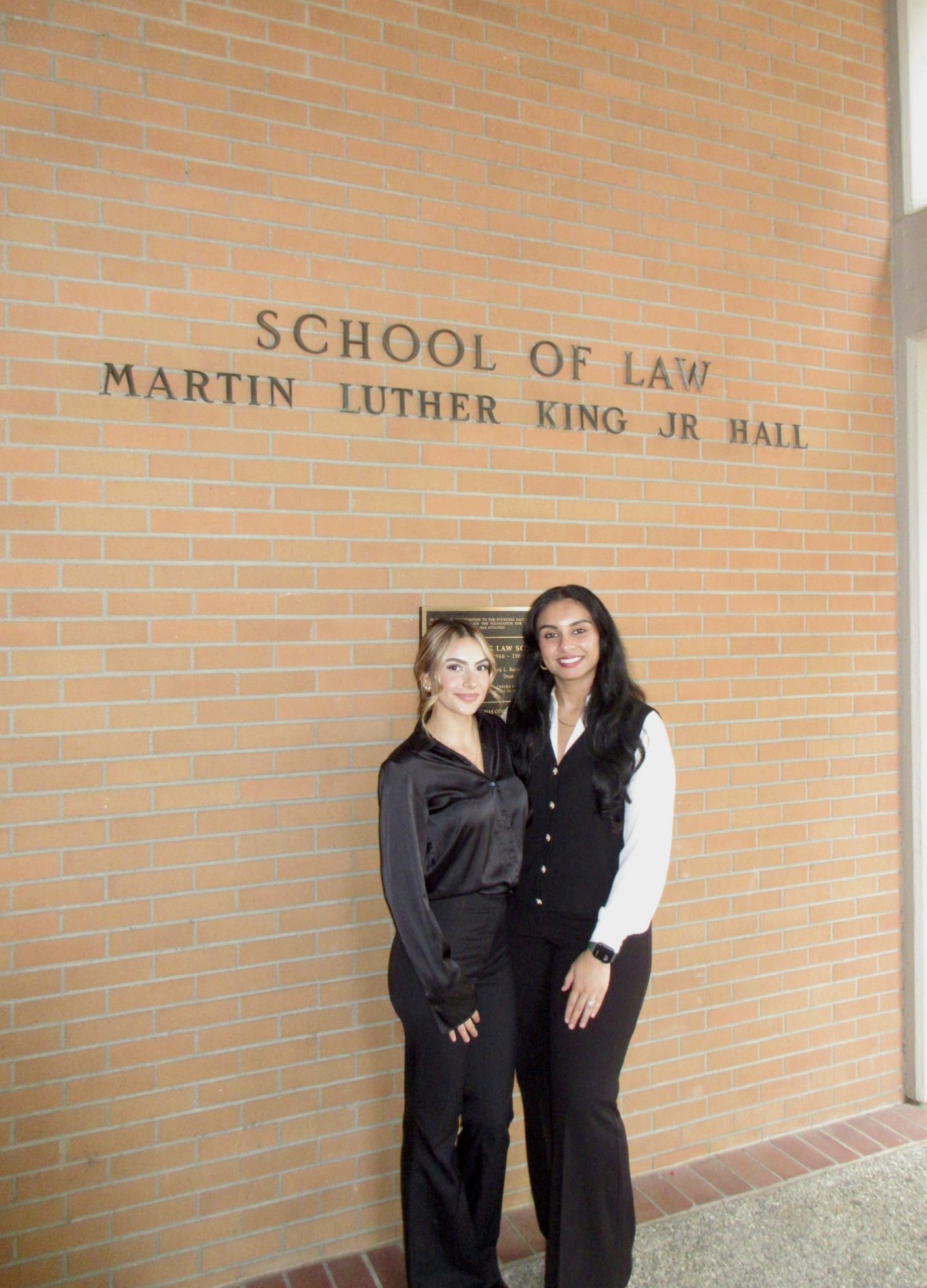
Harman Gakhal and Ashley Maldonado at UC Davis School of Law (King Hall).
Meeting with Harman at King Hall reminded me why I started Her Path to Law. Hearing from women who have successfully navigated law school helps make this path feel more achievable. Harman's story is one of resilience, mentorship, and giving back to the next generation of legal professionals.
Resources:
Below are some of the programs and organizations we discussed that may be helpful for students interested in pursuing law school.
Gonzalez Pre-Law Academy (GPLA) *UC Davis Students*
The Gonzalez Pre-Law Academy (GPLA) is a pipeline program that helps undergraduate students prepare for law school through mentorship, professional development, networking opportunities, and law school admissions support.
As a GPLA student myself, I can confidently say that the program has provided me with invaluable mentorship, resources, and opportunities to connect with attorneys, law students, and legal professionals.
King Hall Outreach Program (KHOP)
KHOP is a pre-law pipeline program offered through UC Davis School of Law that helps students from underrepresented backgrounds prepare for the law school admissions process. Participants receive guidance on law school applications, the LSAT, personal statements, and the legal profession as a whole. KHOP was one of the programs Harman credited with helping her feel connected to the UC Davis Law community before she even enrolled.
Learn more:King Hall Outreach Program (KHOP)
First Generation Advocates (FGA)
First Generation Advocates is a student organization at UC Davis School of Law dedicated to supporting first-generation law students through mentorship, community building, academic support, and professional development.
Harman served as Co-Chair of FGA and described it as one of the most meaningful experiences of her law school journey.
UC Davis School of Law (King Hall)
Throughout our conversation, Harman spoke highly of the supportive environment at UC Davis School of Law. According to recent school data, the student body is approximately 57% women and 59% students of color, creating a diverse and welcoming learning environment.
UC Davis Law also reported a first-time California Bar Exam passage rate of approximately 93%, one of the strongest outcomes among California law schools.
Learn more:UC Davis School of Law (King Hall)
Professional Organizations Mentioned by Harman
Harman encouraged students to become involved in professional organizations and bar associations early because networking often leads to mentorship and career opportunities.
Some organizations she specifically mentioned include:
Harman's Networking Advice:
Reach out to attorneys and law students.
Don't be afraid to send LinkedIn messages.
Attend networking events and panels.
Apply for opportunities even if you don't think you'll get them.
Ask questions.
Follow up and stay in touch with mentors.
